
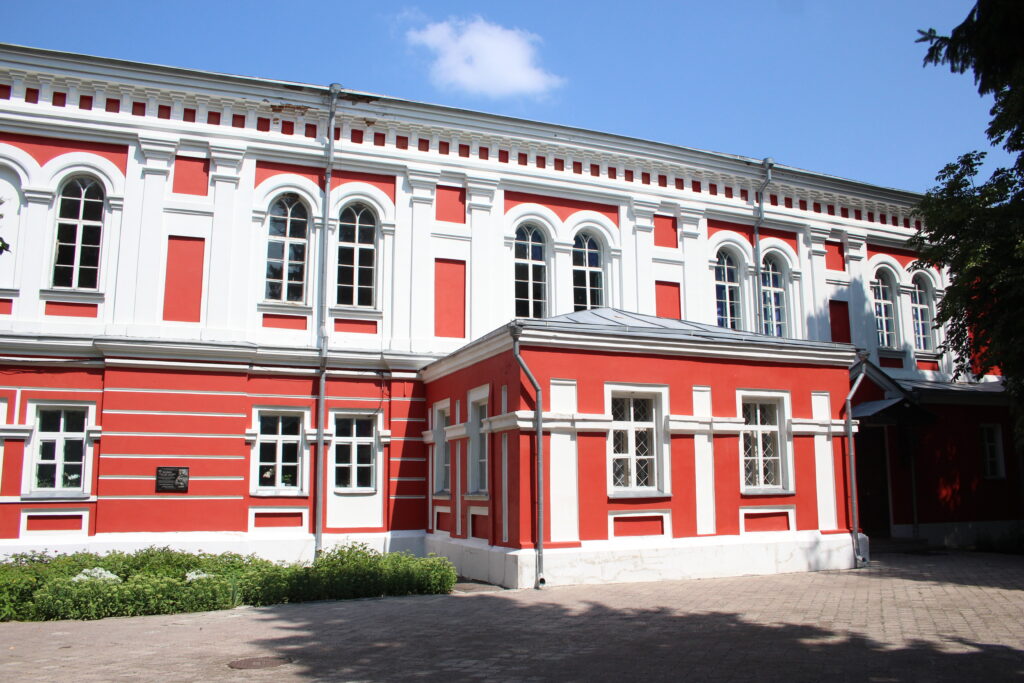
Hlukhiv Teachers’ Institute
a historical and architectural monument of national importance
(Hlukhiv, Kyivska St., 24)
In the very heart of Hlukhiv stands an elegant building in the classical architectural style of the 19th century – the Hlukhiv Teachers’ Institute. Founded in October 1874 as a pedagogical institution with a three-year curriculum, it trained teachers for city schools. The first director, O. Biliavskyi, a student and friend of K. Ushynskyi, established a solid material and academic base, including a fundamental library and a highly professional teaching staff that became a true intellectual community. Among the prominent lecturers were I. Andrievskyi, V. Holubev, M. Demkov, M. Trostnikov, P. Zhyteckyi, as well as artists V. Mokhov and O. Shaporin.
By 1917, many notable graduates had emerged from the institute, including S. Sergeev-Tsensky and S. Vasylchenko, who achieved recognition in literature and education. In honor of the distinguished alumnus, film director and writer Oleksandr Dovzhenko, a memorial plaque with his bas-relief adorns the main façade.
The Teachers’ Institute building, together with the historical monuments Hlukhiv Men’s Gymnasium and the Gymnasium Guesthouse, forms the Humanitarian and Educational Complex located in the eastern part of the city’s historic center. The site is now landscaped and pedestrianized as part of the Oleksandr Dovzhenko Hlukhiv National Pedagogical University campus.
The building was included in the State Register of Immovable Monuments of Ukraine (Cabinet of Ministers Resolution No. 929, 10.10.2012) as a monument of architecture and history (No. 180031/1-N).
Its origins date back to the late 19th century. The well-known entrepreneur Artem Tereshchenko commissioned architect O. Gross to design several buildings for his own needs. In 1871, the Hlukhiv Zemstvo Administration purchased this land and unfinished buildings for 30,000 rubles. Initially, it was planned to house a school, an almshouse, and a Zemstvo hospital. However, in 1873, the Zemstvo decided to transfer the incomplete hospital building for the establishment of a Teachers’ Institute, and in 1874 construction was continued under the design of Kyiv architect P. Shleifer.
The building, with an area of 2,177.6 m² and a volume of 9,581 m³, has two to three stories and a basement. Its U-shaped plan features a corridor layout with classrooms along one side. The front façade faces Kyivska Street and is distinguished by an asymmetrical composition with a one-story entrance portico, an entablature with a frieze of brackets, and paired arched windows divided by pilasters. The two-tone exterior—red with white architectural details—creates an elegant neoclassical harmony.
Throughout its existence, the building underwent several reconstructions: a third floor and a reception room were added (1878–1879), and in 1903–1904 an extension for a two-class school and the St. Dimitry of Rostov house church was built.
Today, the historic Teachers’ Institute is Building No. 1 of the Oleksandr Dovzhenko Hlukhiv National Pedagogical University. Here, in 1956, the oldest Faculty of Primary Education was founded, training more than 11,000 teachers over the years—many of whom earned academic degrees, honorary titles, and state awards.
Currently, the building houses the Educational and Scientific Institute of Pedagogy and Psychology. On the second floor, the Historical and Pedagogical Museum, founded in 1910, continues to operate as a center for research, education, and public engagement. Its exhibits—documents, books, personal belongings, and photographs—illustrate the proud history of one of Ukraine’s oldest pedagogical institutions. Nearby is the Academic Council Hall, a venue for academic and ceremonial events that preserves the spirit of university tradition.
References
- Almanac of University Glory. Oleksandr Dovzhenko National Pedagogical University of Glukhiv (1874–2019) / chief ed. Kurok O. I. Sumy: Private Enterprise “Publishing House “Ellada”, 2019. 196 p.
- Belashov V. I. Glukhiv – the capital of Hetman Ukraine (1708–1782): (from the first settlements to the present day). Sumy: LLC “VPP “Printing Factory”, 2019. 420 p.
- Belashov V. I., Gurets M. P., Zaika V. V. Glukhiv State Pedagogical Institute (1874‒1994). Sumy: Mriya, 1994. 80 p.
- Vechersky V. V. Monuments of architecture and urban planning of Left-bank Ukraine: Identification, research, fixation / V. V. Vechersky. Kyiv: Publishing House ACC, 2005. 586 p.
- Glukhiv National Pedagogical University named after Oleksandr Dovzhenko: 150 years of development: monograph / edited by O. Kurka, N. Tkachenko, A. Hrytsenko. Glukhiv, 2024. 626 p.
- Zadorozhna L. V. Pedagogical achievements of teachers of the Glukhiv Teacher’s Institute of the pre-revolutionary period (1874‒1917). Glukhiv: RVV GNPU named after O. Dovzhenko, 1999. 76 p.
- Kryzhanivsky V. M. Graduates of the Glukhiv Teacher’s Institute (1874‒1906): biographical dictionary. Glukhiv: RVV GNPU named after O. Dovzhenko, 2019. 136 p.
- Miroshnychenko O. How the Zemskaya Hospital became a Teacher’s Institute. Sobornyi Maidan. 2019. No. 4. P. 1‒2.