Triohsviatytelska Tserkva
(Hlukhiv)
The Triohsviatytelska Church (Church of the Three Holy Hierarchs) was a now-lost monument of brick ecclesiastical architecture in Hlukhiv, dating from the second half of the 18th century. It stood in the historic suburb of Belopolivka, at the corner of what are now Blahodatna and Triohsviatytelska Streets (formerly Artema / Prostokvashynska and Klara Tsetkin Streets).
The earliest known depiction of the church in Belopolivka appears on the 1724 plan of Hlukhiv. Although schematic, the plan provides a general understanding of its form. At that time, the church was wooden and tripartite, with three log sections of equal height, topped by double-pitched roofs over the nave and altar, a three-pitched roof over the narthex, and an iron-covered rounded central dome. When compared with the St. Nicholas Church shown on the same map, the Triohsviatytelska Church appears about half its size. The churchyard was densely surrounded by private dwellings.
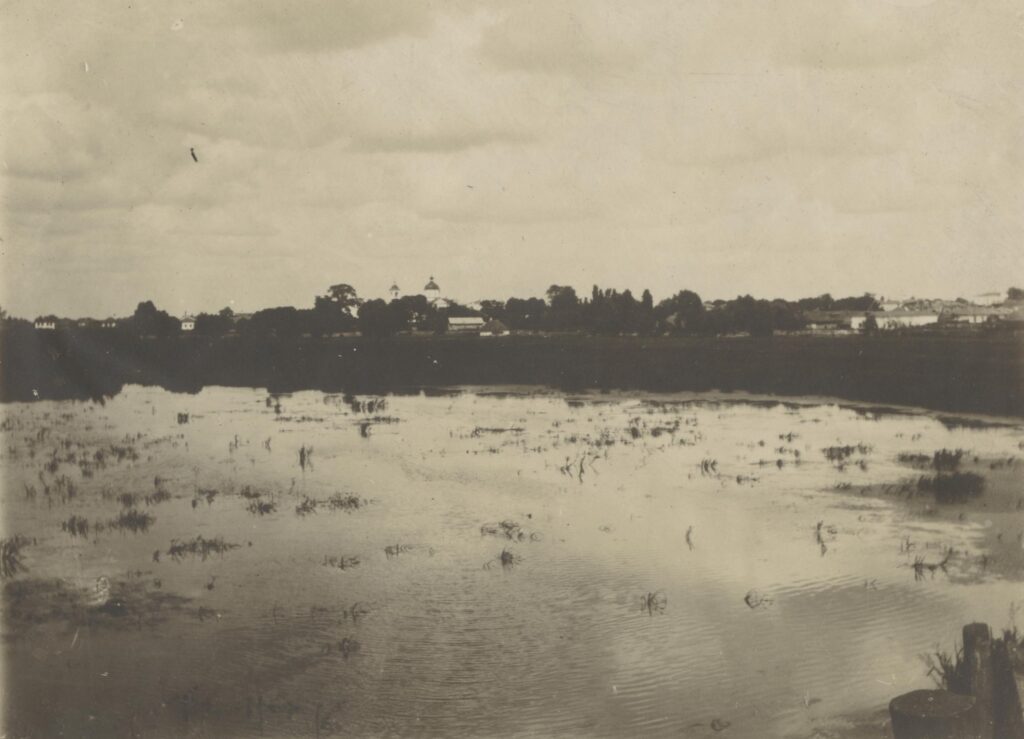
On the 1778 plan of Hlukhiv, the same location bears the name “Church of the Descent of the Holy Spirit.” It is possible that this name referred to the earlier wooden church that preceded the later brick Triohsviatytelska Church. However, historian Vasyl Putsko, who studied the topography of Hlukhiv’s churches, considered this a cartographic error, since the church was already consecrated as Triohsviatytelska in 1767. According to him, the mistake likely occurred because the 1778 plan was prepared in the Russian capital based on outdated information.
Additional evidence comes from the Diariusz of Mykhailo Khanenko, which mentions in June 1742 the Church of St. Basil the Great in Belopolivka, where his wife and daughter attended an all-night vigil. Another record, dated July 29, 1744, preserved in the archives of Hlukhiv’s Trinity Cathedral, refers to taverns operating near the Church of St. Basil the Great in Belopolivka. This likely refers to the same church later known as the Triohsviatytelska, since one of its patron saints was St. Basil the Great, and a side altar was consecrated in his honor.
The Historical and Statistical Description of the Chernihiv Diocese (1873) states:
“On the Rumyantsev plan, the Church of the Three Holy Hierarchs is not shown among the existing churches, and its place is occupied by the Church of All Saints in the cemetery. The Church of the Descent of the Holy Spirit behind the Chernecha Dam is also marked.”
On the 1875 plan of Hlukhiv, the stone Church of the Three Holy Hierarchs appears on its historic site, within an L-shaped undeveloped block between Tereshchenkivska and Prostokvashynska Streets. A brick building is indicated in the western corner of this block, which retained its form in city plans of 1910 and 1913. On another early 20th-century plan, the church is labeled simply “Three Saints.”
Archival documents of the Chernihiv Spiritual Consistory (State Archives of Chernihiv Oblast, Fund No. 679, Files 387 and 388) provide information about Hlukhiv’s churches and clergy at the beginning of the 20th century, including the Church of the Three Holy Hierarchs. They confirm that the stone church was constructed in 1780 at the expense of parishioners, with the bell tower added somewhat later.
Information on religious life in the Chernihiv Diocese during the late 19th and early 20th centuries can also be found in the diocesan journal Chernihiv Eparchial News. From the 1861 issue, we learn that the priest of the Church of the Three Holy Hierarchs in Hlukhiv was Yevmenii Rosynskyi.
The only known surviving drawing of the church, discovered in the State Archives of Chernihiv Oblast, comes from the file “On the approval of drawings for the construction of stoves in the Church of the Three Holy Hierarchs in Hlukhiv” dated July 23, 1897. It indicates that the church was heated, containing three round stoves, and had one main altar dedicated to St. Basil the Great, St. Gregory the Theologian, and St. John Chrysostom. The parish staff consisted of a priest and a psalmist who did not receive state salaries. In 1911, the church’s annual income exceeded 300 rubles, including about 250 rubles from donations and 44 rubles 23 kopecks in interest from a deposit of 1,100 rubles. The parish also owned three-quarters of a tithe of fertile household land, generating about 20 rubles per year.
The church owned two houses built in 1884 and 1894 through parishioner and Tereshchenko family donations; both later required substantial repairs. The priest’s and psalmist’s residences included two wooden sheds and woodsheds. In the southeastern corner of the cemetery stood a wooden, brick-lined storage hut, and within the churchyard was a wooden guardhouse. Parish registers had been maintained since 1780, and confessional lists since 1815.
The parish oversaw a city parish school and a craft school named after Mykola Tereshchenko. The churchwarden was Hryhorii Mykhailovych Kozlov, and the rector was Archpriest Fedor Petrovych Kostenetskyi, a graduate of the Chernihiv Theological Seminary. He was married to Varvara Epifaniivna and had five children.
Records of parish demographics show that the congregation consisted of nobles, honorable citizens, townspeople, merchants, Cossacks, peasants, soldiers, non-believers, and non-Slavic residents. 210 households were attached to the parish, comprising 574 men and 664 women.
During the national and revolutionary period of 1917–1921, the movement for the Ukrainization and autocephaly of the Orthodox Church spread across Ukraine. In 1927, the Belopolivka community of the Ukrainian Autocephalous Orthodox Church (UAOC) was established at the Trinity Church in Hlukhiv. However, at that time the building remained under the control of the Old Church Slavonic community. Disputes arose between the two groups over the right to use the church. The UAOC proposed alternating services, but this was rejected. The authorities ruled in favor of the Old Church Slavonic community, noting that it was the only such congregation in the city and that the autocephalists should worship elsewhere. In 1930, the UAOC was dissolved for alleged “anti-Soviet activities,” which ended its presence in Hlukhiv.
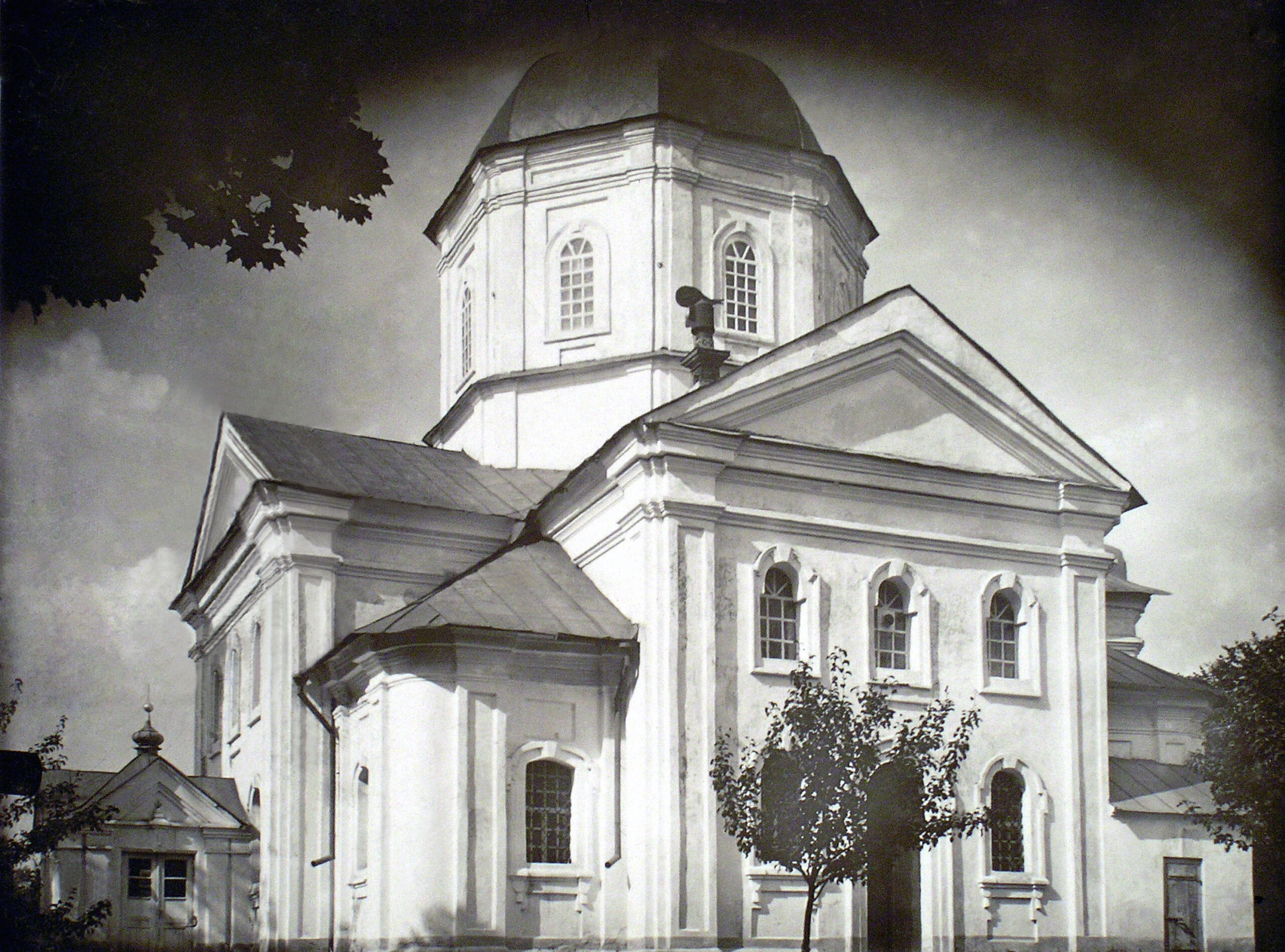
Of particular importance are photographs of the Church of the Three Holy Hierarchs, taken in 1930 by Pavlo Mykolaiovych Zholtovsky during his research trip to the Chernihiv region to document local stone architecture. These photographs were rediscovered in 2008 by staff of the Hlukhiv National Reserve in the collections of the Institute of Manuscripts of the V. I. Vernadsky National Library of Ukraine, following consultations with art historian Vasyl Hryhorovych Putsko, a native of Hlukhiv. Putsko provided information about the archive preserving these unique photographs, which until then had never been published. He also mentioned sacred relics of the church—the main altar icon and the Balykyn Mother of God icon—which had been transferred to the Ascension Church. Their later fate remains unknown.
These photographs appear to be the last taken before the church’s destruction during the period of “militant atheism.” German aerial photographs from September 1943 show the block where the church once stood, but no visible traces of its foundations or ruins, only overgrown trees that had once been part of the church’s hedge along Tereshchenkivska and Blahodatna Streets.
The exact location of the Church of the Three Holy Hierarchs can only be established through official archaeological investigations.
References
- Putsko, V. H. From the Historical Past of Hlukhiv. Sivershchyna in the History of Ukraine: Collection of Scientific Works, Vol. 3. Kyiv–Hlukhiv, 2010, pp. 185–187.
- Kovalenko, Yu. O. Historical Topography of Hlukhiv in the Middle Ages and Early Modern Times. Nizhyn, 2024. 224 p.
- Moshyk, I. V. The Ukrainian Autocephalous Orthodox Church in Hlukhiv in the 1920s–1930s. Sivershchyna in the History of Ukraine: Collection of Scientific Works, Vol. 10. Hlukhiv–Kyiv, 2017, pp. 364–368.
- Blakytnyi, M. M. Lists of Church Officials of Hlukhiv, Konotop, and Krolevets Counties of Chernihiv Province in 1861 (Based on the Journal “Chernihiv Eparchial News”). Sivershchyna in the History of Ukraine: Collection of Scientific Works, Vol. 10. Hlukhiv–Kyiv, 2017, pp. 295–299.
- Shyshkina, Yu. A. Parish Life of Hlukhiv in the Late 19th – Early 20th Centuries. Sivershchyna in the History of Ukraine: Collection of Scientific Works, Vol. 7. Kyiv–Hlukhiv, 2014, pp. 208–213. Miroshnychenko, O. The Trinity Church in Hlukhiv. Sobornyi Maidan, 2016, No. 3, pp. 7–8.