
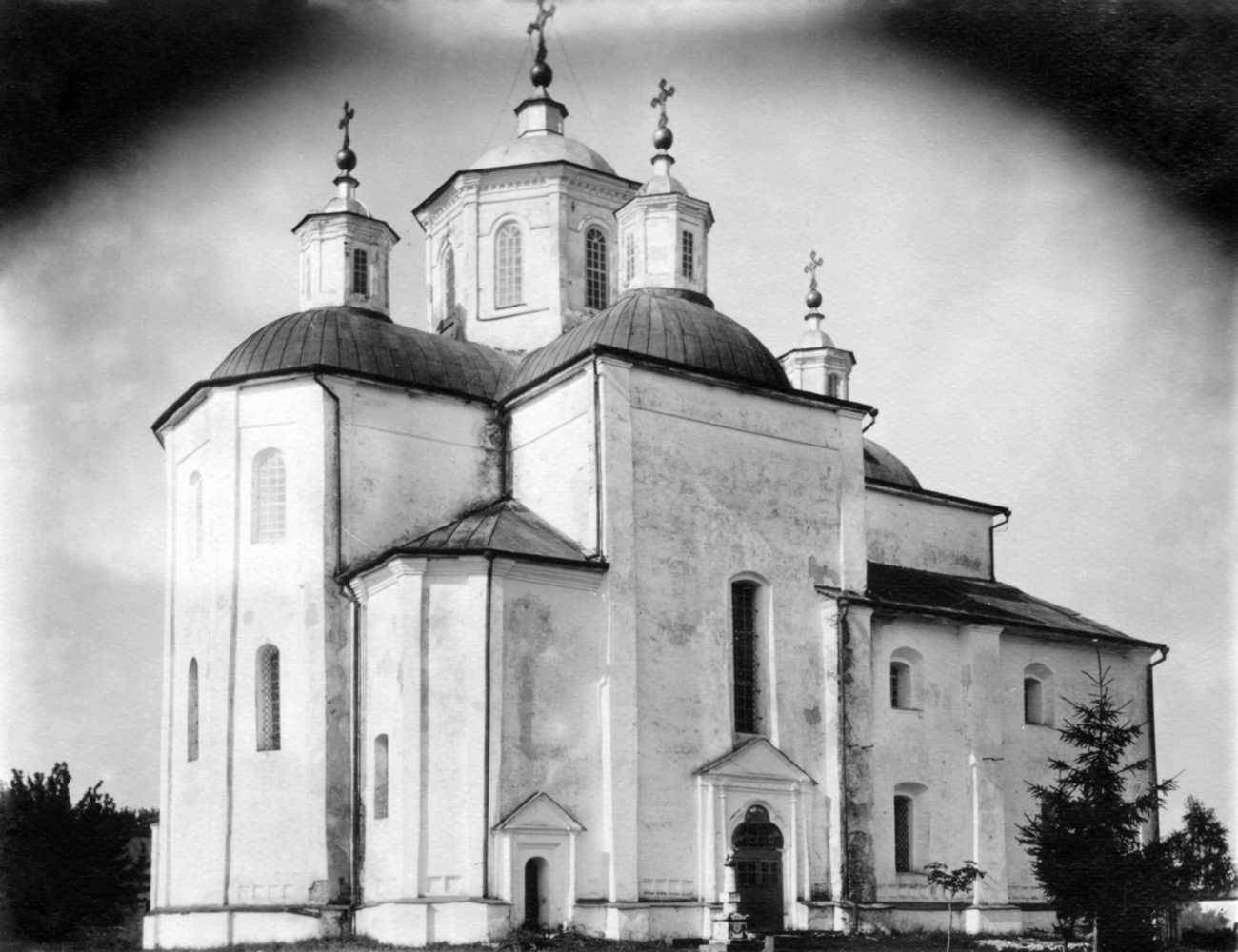
Sobor Rizdva Bohorodytsi
(Hamaliivka)
The ensemble of the Hamalivka Monastery (17th–18th centuries) in the village of Hamaliivka is a monument of architecture and urban planning of national importance (Protection No. 180065). The architectural complex consists of the Cathedral of the Nativity of the Virgin (1719–1735), the Church of St. Haralampius (1714–1722), monastic cells (1781–1794), and a defensive wall (1781–1794).
The Hamalivka (or Haralampiiv) Monastery is located on a high bank of the Shostka River in the village of Hamaliivka, now a suburb of the city of Shostka.
Historical Background
The history of the monastery is closely linked to the Cossack elite of the Hetmanate era, particularly General Osavul Anton Hamalia and Hetman Ivan Skoropadskyi. The first wooden Church of St. Haralampius was built in 1702 at the expense of A. Hamalia. Around it, a small nunnery — Haralampiivska Pustynka — quickly emerged. In 1713, through the efforts of Hetmansha Nastia Skoropadska, the monastery was transformed into a full-fledged convent with appropriate rights and property.
It is traditionally believed that the idea to build the monastery originated with Hetman Ivan Skoropadskyi in 1713, as this is the date of the foundation charter. However, primary sources indicate that as early as 1712, local residents knew that the Hetman intended to build a new monastery. Encouraged by the nobility, they donated or sold their property—forests, hayfields, and houses with gardens—to the monastery. In 1714, Hetman Skoropadskyi proclaimed himself the titular patron of the monastery. The large-scale construction of this spiritual center began around 1718 and required significant labor and material resources—bricks, timber, and lime—all of which were procured in advance.
The architectural concept of the Hamalivka complex followed the model of a defensive-type monastery, similar to the Transfiguration Monastery in nearby Novhorod-Siverskyi. The monastery had a clearly defined defensive layout: a quadrangular wall with four corner towers, three gate towers, and powerful ramparts that symbolized a spiritual fortress despite the convent’s female status.
Construction and Development
Hetman Skoropadskyi died in 1722 before completing the construction of the monastery. His wife, Anastasia Skoropadska, passed away in 1729. In accordance with the Hetman’s will, the monastery was transformed from a convent into a male monastery in 1733, with monks transferred from the Mutyn Monastery near Krolevets. The first abbot was Herman Konashevych, under whom all brick structures were completed, including the Cathedral of the Nativity of the Virgin (Protection No. 180065/1), designed by the “mason” Danylo Moiseievych.
In 1735, Archimandrite Mykola Lenkevych, Konashevych’s successor, consecrated the cathedral. It contained four side altars: to St. Barbara the Martyr, the Synaxis of the Twelve Apostles, St. James the Confessor, and St. Nicholas. The cathedral served as the central dominant of the ensemble. The imposing five-domed, three-nave structure impressed with its austere monumentality, smooth undivided planes, and complete lack of ornamentation. It was a six-pier, triapsidal basilica—an adaptation of Old Rus’ three-nave, cross-in-square churches typical of the Mazepa era. The façades were articulated by pilaster strips, and the main and side entrances featured distinct portals; the main western entrance was framed by massive pylons connected by a semicircular arch.
Interior and Artistic Heritage
The cathedral was adorned with a magnificent four-tiered Baroque iconostasis spanning the entire width of the nave. It featured the Skoropadskyi family coats of arms, gilded carved columns, and vine motifs. The cathedral once housed portraits (parsuny) of the Skoropadskyi family, painted by Yakym Hlynsky. In the 19th century, these portraits were moved to the abbot’s quarters, later transferred to the Hlukhiv Museum of Local Lore, and eventually to the Sumy Art Museum named after N. Onatsky. Some art historians believe that the originals did not survive, and only later copies remain.
The main relics of the Cathedral of the Nativity of the Virgin included the Kerbutiv Miraculous Jerusalem Icon of the Mother of God in a silver riza and a copy of the Chernihiv Ilyinsk Icon of the Mother of God. The cathedral also possessed silver-gilt lamps donated by the Skoropadskyi family—remarkable examples of 18th-century Ukrainian metalwork. Its liturgical books mainly belonged to early 18th-century Kyiv, Chernihiv, and Moscow editions.
Architectural Features of the Complex
The monastery’s defensive perimeter formed an irregular trapezoid measuring about 170 × 180 meters. The brick wall, 2.2 meters high and 1.3 meters thick, originally had a gabled roof and four octagonal corner towers with pilasters. Loopholes were arranged at a height of 1.2 meters. A fifth octagonal tower with a utility gate stood in the southern section. The towers had vaulted chambers with loopholes and battlements, later topped with domed or spherical roofs (after 1794).
In the western wall stood the main gate tower-bell tower (not preserved), aligned with the cathedral’s central axis and serving as the main entrance. Built before 1735, it was a simplified replica of the Holy Gate of the Novhorod-Siversky Transfiguration Monastery. Initially three-tiered, it was crowned with an elaborate Baroque top.
At the bend of the northern wall stood another two-tiered, four-sided gate tower resembling an ancient “zahab” (entrance tower). Today, the remains of these fortifications are protected as a national architectural monument under the title “Defensive Wall of the Hamaliivka Monastery” (Protection No. 180065/4).
The Church of St. Haralampius (Protection No. 180065/2) with an attached two-story refectory and rectory is located in the western part of the northern wall. The church, rectangular in plan and single-domed, has a hall-type layout with a faceted apse and a large summer refectory (added in the 1770s). The altar is crowned with a spherical dome on a light octagon. The rectory is rectangular with an enfilade plan, covered by a single hipped roof. The northern wall contains loopholes, and one of the corner towers adjoins the northwest corner. The Church of Harlampiі became the burial place of six members of the Skoropadskyi family.
To the southwest of the cathedral stands an L-shaped, two-story building of monastic cells (Protection No. 180065/3). Originally wooden, these cells were rebuilt in brick between 1780–1795 as a single-story structure; the second story was added in the mid-20th century. The layout included living quarters and utility halls opening onto inner courtyards. The façades were divided by rusticated pilasters and crowned with a projecting cornice.
Through its severe and laconic architecture, the Hamalivka Monastery resembled an austere, impregnable fortress.
Decline and Later Fate
Over its three-hundred-year history, the monastery suffered repeated fires (in 1738 and 1794), reconstructions, and eventual decline due to the policies of the Russian Empire and later the Soviet authorities.
In the 20th century, the complex experienced its greatest devastation. After its closure in 1920, the buildings lost their sacred function—first transferred to an artel, then to a collective farm in the 1930s–1950s. The Cathedral of the Nativity of the Virgin was used as a granary, while the Church of St. Haralampius remained the parish church for Hamaliivka. The monastic cells housed local residents.
In 1956, the monastery was declared an architectural monument of republican significance. Researcher Mykhailo Tsapenko, who visited in the late 1950s, wrote:
“In a small refectory church, Skoropadskyi and his wife are buried. Their graves are marked by finely carved white stone slabs—rare works of art that, miraculously, have survived in such a remote place. The monastery buildings are neglected, but fortunately, they still stand.”
However, in 1962, the Sumy Regional Executive Committee transferred the monastery to the Ministry of Internal Affairs, which converted it into a strict-regime prison (Enterprise 319/66). The following year, the ensemble was removed from the state register of monuments and handed over to the penal system. The defensive walls and towers were demolished, and three gatehouses destroyed. The cathedral and the Church of St. Haralampius were converted into industrial workshops: reinforced-concrete floors and columns were installed, and a water tank placed beneath the central dome. The tombstones of the Skoropadskyi family were encased in concrete, and the monastic cells were turned into prison cells.
In 1987, the remnants of the monastery were once again taken under state protection as an architectural monument (Protection No. 1553).
Finally, on June 19, 2019, recognizing the exceptional cultural, historical, and architectural value of the Hamalivka Monastery complex, the Cabinet of Ministers of Ukraine established the State Historical and Cultural Reserve “State Builders of the Sivershchyna.”
References
- Vechersky V. Lost objects of architectural heritage of Ukraine. Kyiv: NDITIAM – Golovkiivarkhitektura, 2002. 592 p.
- Vechersky V. Orthodox shrines of Sumy region. Kyiv: Technika, 2009. 224 p.
- Yurchenko S. B. Gamaliev Monastery during the time of Hetman Ivan Skoropadsky. Siverschyna in the history of Ukraine. 2012. No. 5. P. 30–35.
- Kovalevska O. Secrets of Cossack portraits. Kyiv: Clio, 2019. 288 p.
- Chernyakova Ya. V. Gamaliev Kharlampievsky Monastery: an architectural monument or a prison? Karnabid Readings. 2019. No. 4. P. 248–253.