
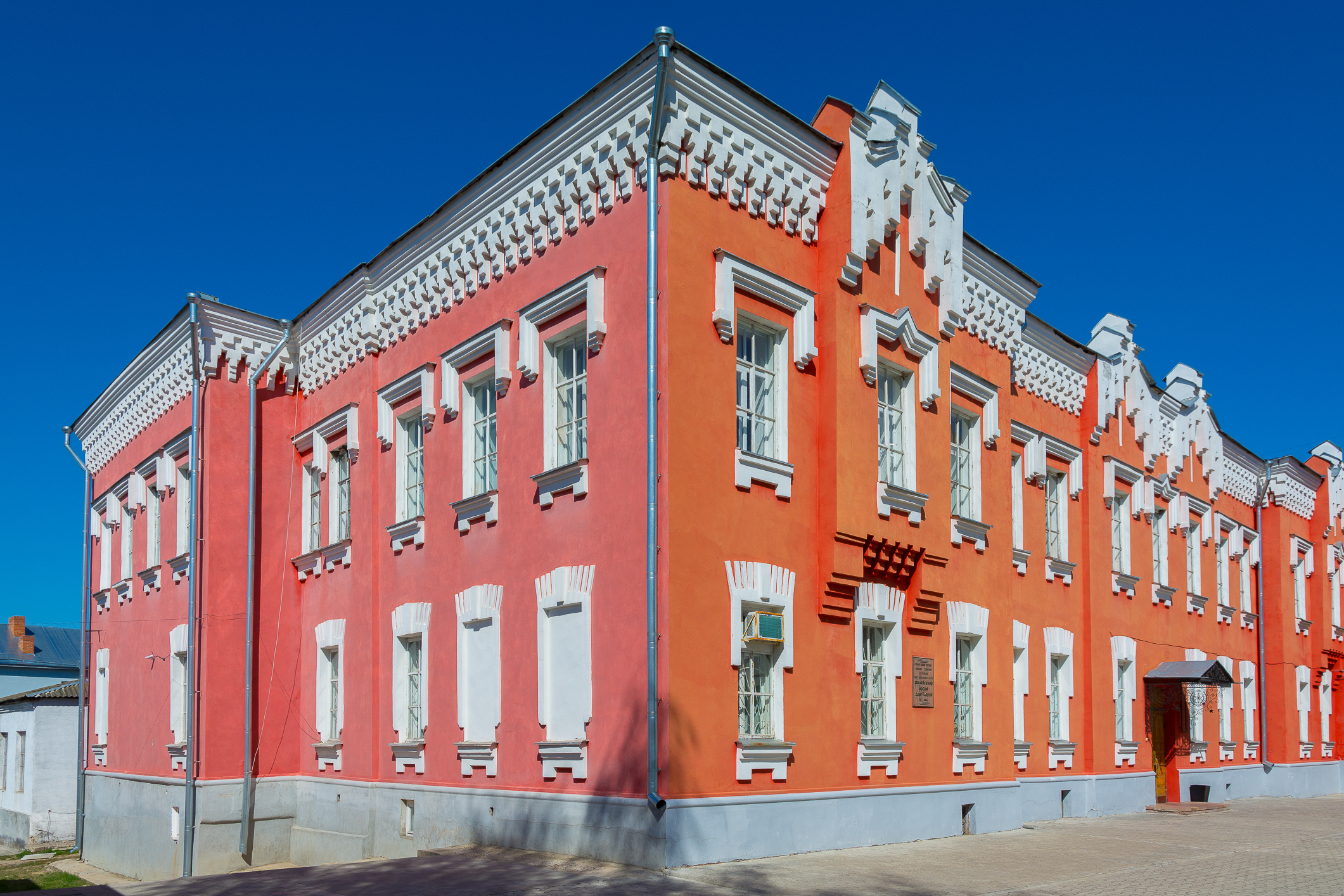
Boarding House of the Hlukhiv Boys’ Gymnasium
an architectural and historical monument of national importance
(Hlukhiv, Kyivska St., 24)
One of the first secondary educational institutions in Hlukhiv was the county school, which on July 1, 1870, was transformed into a four-grade male progymnasium. In 1875, it became a six-grade school with an additional preparatory class. Each year, the institution enrolled between 200 and 250 students, approximately 30% of whom came from outside the city. Since the Hlukhiv progymnasium lacked a boarding house or dormitory, non-resident students were forced to rent private accommodation.
On July 1, 1889, the progymnasium was reorganized into the Hlukhiv Classical Gymnasium, offering an eight-grade curriculum. Between 1890 and 1892, a two-and-a-half-story boarding house was constructed adjacent to the gymnasium building at the expense of Mykola Artemiyovych Tereshchenko, to provide accommodation for non-resident students. Even before construction began, the director of the Hlukhiv Gymnasium Mykhailo Fedorovych Lazarenko and Tereshchenko himself had to conduct extensive negotiations with higher educational authorities to obtain approval for the project. As a result of numerous design revisions, the building acquired its distinctive architectural appearance.
Tereshchenko and the gymnasium administration realized that constructing and equipping the boarding house would not be difficult, since all expenses were fully financed by the benefactor. The challenge lay elsewhere — convincing officials from the Ministry of Public Education and the Kyiv Educational District to accept such an “expensive gift” into state maintenance, as the institution required a full permanent staff. The total construction cost reached 54,750 rubles, and an additional 4,000 rubles were needed for the first year of operation. To resolve these issues, the Economic Committee of the Hlukhiv Gymnasium was formed under the chairmanship of Director Lazarenko, with Tereshchenko and College Adviser P. V. Bek as members. It was decided that once the building was completed in August 1892, Tereshchenko would transfer ownership of the boarding house to the gymnasium, which would then hand it over to the Educational Department.
Funding for the institution’s maintenance was obtained not through state subsidies or auctions but through local economic means — effectively redirecting funds from other municipal institutions to cover expenses. A protocol from the building’s acceptance commission provides a detailed description of its original layout, furnishings, and household items.
A preserved description reads:
“A two-and-a-half-story stone building with an iron roof; a vestibule with oak front doors and a stone staircase.
On the ground floor — the inspector’s apartment with five rooms, a kitchen, water closet, pantry, and a rear exit to the yard.
On the opposite side — a dining room for boarders, buffet, reception room, dressing room, and rooms for the steward (housekeeper) and guards, with a wooden staircase leading down to the kitchen.
On the upper floor — a chapel with an oak-carved iconostasis, two classrooms, two dormitories (common bedrooms), a warder’s room, a spare room, a washroom, and a water closet, as well as a back staircase and access to the attic.
In the basement — a kitchen with a steam oven and stove, two rooms for servants, a pantry, and two cellars for the boarding house and the inspector’s apartment.
Outbuildings included a stable shed, carriage shed, storerooms, an icehouse for the boarding house and the inspector’s apartment, a well, and a latrine.
The building contained 26 stoves (24 Dutch tiled and 2 Russian), 2 fireplaces, 96 windows (38 on the first floor, 44 on the second, and 14 in the basement), and 44 doors.
The boarding house was fully furnished with portraits, furniture, lamps, and kitchen and buffet utensils.”
Due to the delayed arrival of the Head of the Kyiv Educational District in Hlukhiv, the official opening of the Boarding House of the Hlukhiv Boys’ Gymnasium was postponed several times. Although the opening ceremony took place on October 14, 1892, 19 students had already moved in by September 15 of that year. By 1898, the boarding house accommodated 38 students. Among them were the future artist Heorhiy Narbut and poet Volodymyr Narbut.
Over time, the building lost much of its original interior design, despite the preservation of its façades. For many years, it was not used for its intended purpose, resulting in internal restructuring. The original tiled stoves and fireplaces were removed, stair railings replaced, and rooms converted into classrooms.
The historical and architectural monument “Boarding House of the Hlukhiv Boys’ Gymnasium” is located within the National Reserve “Hlukhiv”, behind the main gymnasium building, with its southern façade facing Kyivska Street. Built between 1890 and 1892, the structure served as a dormitory for gymnasium students.
The two-story brick building has a rectangular plan elongated along the west–east axis and features a symmetrical layout. Its corridor-type interior plan includes rooms arranged on both sides of a central passage. On the first floor, along the main transverse axis, there is a lobby and a double-flight staircase. On the second floor, the north-eastern corner houses the St. Nicholas Gymnasium Chapel — a single-hall rectangular space with a semicircular apse visible from the eastern façade.
The main southern façade is symmetrical and three-axial, executed in neo-Gothic style. Each axis is emphasized by reinforced projections, while the central and lateral entablatures are crowned with stepped Gothic gables. The building features a pronounced base and an elaborate cornice, incorporating an arched frieze, a band of brick “rusks,” and a finely profiled molding.
All windows are rectangular and vertically elongated, with prominent window sills and moldings. The first-floor windows are topped with wedge-shaped lintels in relief, while the second-floor windows have massive profiled frames. Both interior and exterior walls are lime-plastered. The façades are painted in a traditional two-tone color scheme: red background with white architectural details.
The ceilings are flat on wooden beams; the floors are wooden planks; and the hipped roof, supported by wooden rafters, is covered with roofing steel. The building’s total area is 1,899.8 m², and its total volume is 8,359.1 m³.
No significant reconstructions or losses have occurred. In the 1960s, a one-story annex was added to the rear façade. No restoration work was undertaken in 2001, and the general technical condition of the monument is currently assessed as satisfactory.
The buildings of the Teachers’ Institute, the Hlukhiv Boys’ Gymnasium, and the Boarding House together constitute a historically and architecturally valuable educational complex from the era of historicism. The Boarding House is the only building in Hlukhiv constructed in the neo-Gothic style. The architectural ensemble was studied by V. V. Vechersky in 1984, after which it was included in the Collection of Historical and Cultural Monuments of Ukraine (Volume “Sumy Oblast”).
According to the Resolution of the Cabinet of Ministers of Ukraine No. 929 (2012), the site was granted the status of a monument of national importance (protection number 180031/3-N). The building is state-owned and currently used by the O. Dovzhenko Hlukhiv National Pedagogical University, housing the Faculty of Technological and Vocational Education.
References
- Miroshnychenko, O. M. From the History of the Construction of the Boarding House of the Hlukhiv Boys’ Gymnasium. Severshchyna in the History of Ukraine: Collection of Scientific Works, Issue 7. Kyiv–Hlukhiv, 2014, pp. 245–249.
- Vechersky, V. V. Monuments of Architecture and Urban Planning of Left-Bank Ukraine: Identification, Research, Documentation. Kyiv: A.S.S. Publishing House, 2005. 586 p. Scientific Archive of the National Reserve “Hlukhiv.” Passport of the Architectural and Historical Monument “Boarding House of the Hlukhiv Boys’ Gymnasium.”