
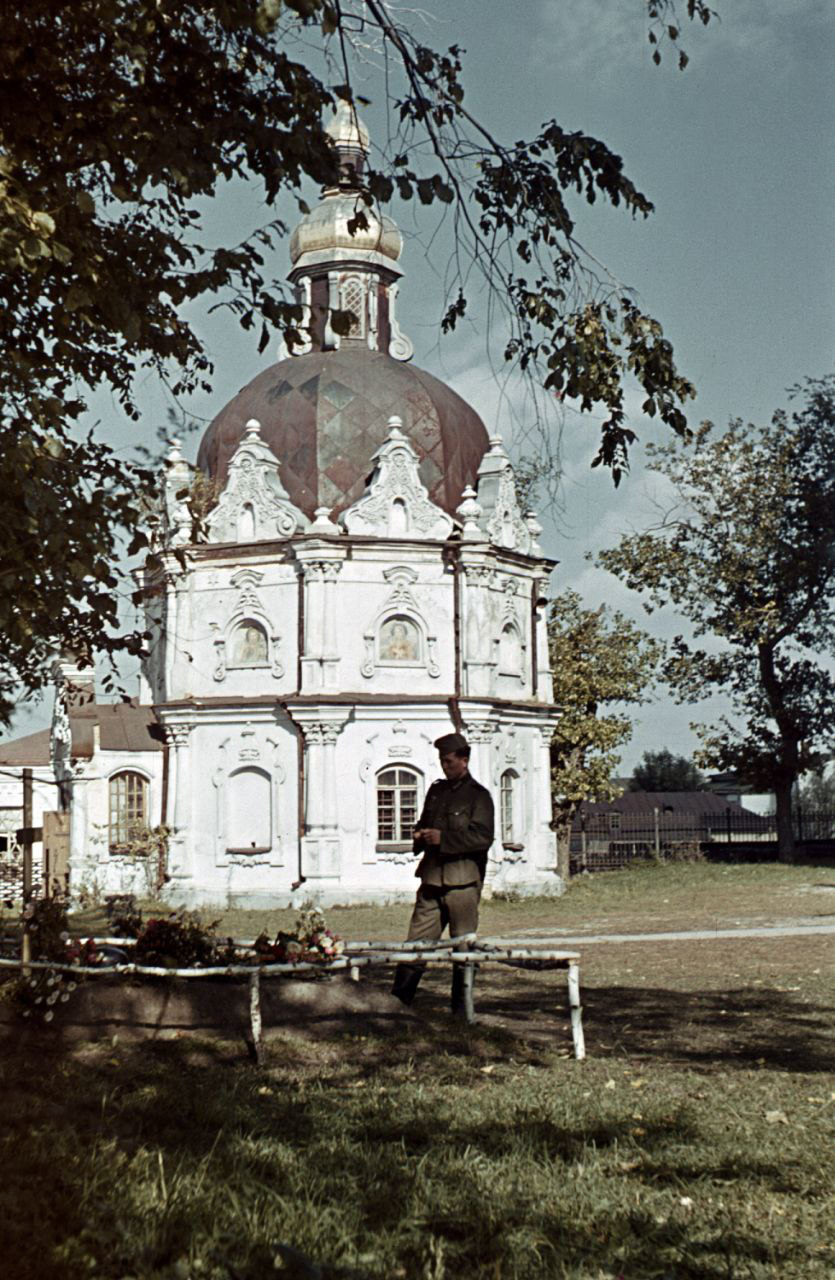
Anastasievska Kaplytsia
(Hlukhiv)
The Anastasievska Kaplytsia (Chapel) or the Chapel of Paul Skoropadsky is one of the lost monuments of history and architecture of the city of Hlukhiv. It was located next to the Three Anastasii Church in the historical center of the city, which in the first half of the 18th century was the hetman’s residence.
The history of the Skoropadsky Chapel began with the petition of members of the Tereshchenko family to demolish the old church of Saints Anastasia, built during the hetmanship of Ivan Skoropadsky.
In 1893, Nikola and Fedor Tereshchenko built a new Three Anastasii Church as a family tomb near the old hetman’s church. On May 21, 1894, the Tereshchenko brothers appealed to the Holy Synod with a request to allow the demolition of the old Hetman’s church, since “the old church, being in the same cemetery as the newly built church, significantly detracts from its majestic beauty.” On January 2, 1895, a corresponding decree of the Holy Synod was issued.
The old Anastasiia Church began to be dismantled, and from its materials it was planned to build a church in the village of Nova Hreblya. Meanwhile, the descendant of the builder of the aforementioned ancient church – Hetman Skoropadsky, cornet of the Cavalry Regiment Pavlo Skoropadsky in 1899 submitted a request to preserve the old church as a family monument, committing to bring it into a “completely acceptable form and maintain it in this form permanently.” The work on the demolition of the church was stopped. During a comprehensive technical inspection of the old church building, P. P. Skoropadsky came to the conclusion that “only that part of it that, as historically proven, constitutes the original structure of his ancestor, namely the main altar in the name of the three Saints Anastasias, with the dungeon, he asked to be allowed to dismantle the rest – the two floors of the church, the bell tower and the babynets – was preserved…
Therefore, P. Skoropadsky decided to save the old Anastasiia church, where the real altar of the early 18th century was miraculously preserved, using these historical remains to build “a kind of spiritual monument to the Ukrainian elders”, including representatives of the Skoropadsky family. Apparently, he was prompted to this act by the indignation of a significant part of Chernihiv society, in particular the descendants of historical families, at the insolence of the Tereshchenkos. A certain role was also played here by P. Ya. Doroshenko, a well-known Chernihiv public figure, expert on Ukrainian antiquity and like-minded person of the future hetman. In 1908, when this grandiose project was already approaching completion, he wrote to P. P. Skoropadsky: “I have long thought about your idea that the chapel should be a monument to the past, that is, to our Hetmanate… Thus, it will be a historical monument, and it should be firm and serious, but without unnecessary fuss and ambition, presented on the board that will be at the entrance to the chapel. By the way: the religious side, educational-spiritual and even church, should play a large role in the inscription, because religion and the church in Little Russia have always, and during the Hetmanate, played such a large role.”
Pavlo Skoropadsky approached the matter very seriously, ordering preliminary sketches of the future chapel from the outstanding artist and at the same time expert on ancient Ukrainian architecture O. Slastion, and Pavlo Petrovych asked for advice on the artistic side of the matter from the famous St. Petersburg architect L. M. Benois, who made another project of the building. Also, regarding the idea of the architectural program of the chapel, the director of the Research Institute of the History of Architecture and Urban Planning in Kyiv, S. B. Yurchenko, made his assumption. In his opinion, the development of the chapel project could have been influenced by the mother of the last hetman – Maria Andriivna Skoropadska, who came from the ancient Cossack-starshyn family of Myklashevsky and took an active position in the issue of restoring ancient buildings.
The idea of the Glukhov chapel was also positively received by V. Novytsky and V. Horlenko, outstanding experts on the Ukrainian past, descendants of the Cossack elders. In particular, the latter wrote: “I like Slastion’s project the most and it seems characteristic.” Benoit’s project, in his opinion, although executed by a very experienced architect, is completely banal, “has no feature that connects it with the era and the people whose memory you wish to perpetuate.” The reconstruction plan, briefly expressed by Skoropadsky himself, was as follows: “… break down everything that was built after its foundation, and leave only what was originally done…”. In fact, it was about the conservation of the old altar of the early 18th century, the dismantling of everything that was added during the 19th century, especially the Tereshchenko “modernization”, and the reconstruction of the new chapel in strict accordance with the style of the 17th century. The young Kyiv architect M. Hardenin, who was involved in the project, already in 1902 concluded an agreement and a project for such a construction. It included the construction of eight new pediments, a large dome with a drum and two small ones, a new roof over the chapel and extensions, extensive finishing work: the use of internal molding, painting, as well as gilding of domes, scaffolding and even mica windows – as in the 17th century.
When developing the drawings, M. G. Hardenin widely used historical evidence, in particular, he studied materials from monastery archives. bliotek (Kiev-Pechersk Lavra, etc.). Skoropadsky especially emphasized this, writing to the architect: “the vault may be beautiful if it is divided, but above all I want to adhere to antiquity and have a vault exactly as it was built in the 17th century.” For the same reasons, he rejected the design of the pediments: “too much symmetry, dryness and complexity of the design, besides, it is very similar to the new style.” M. Hardenin’s proposal to paint the chapel yellow and gild some details on the pediments caused great controversy: “everything should be whitewashed with ordinary lime,” that is, to reproduce the style of the 17th century, the austere era of Bohdan Khmelnytsky.
Archival sources contain information about the construction plan for the Anastasiia Chapel: “…to complete the walls to form a regular building with eight corners, which should be made of the best stone bricks. The foundation should be 0.80 fathoms thick. The thickness of the walls of the 1st floor, which will be illuminated by seven lattice windows and a transom above the entrance door, should be no less than 0.66 fathoms… The vault should be made of the best brick… The chapel should end with a dome, on which a wooden porthole should be based and on it a second small dome with a metal cross mounted in it…” To supervise the reconstruction of the altar part of the old Anastasiia Church, Pavlo and Mykhailo Skoropadsky invited the technician of the Chernihiv provincial zemstvo, Fyodor Grigorovich Nechayev. The chapel project was approved by the Construction Department of the Chernihiv Board on July 23, 1899 and signed by the governor E. Andrievsky, provincial architect Voitsekhovsky, deputy provincial architect Partsky, senior clerk Derevyanko.
Unfortunately, the work in Hlukhiv did not progress as quickly as the future hetman would have liked. In 1903, M. Gardenin began construction, but this caused some dissatisfaction both on the part of the customer (regarding compliance with the original plan) and Chernihiv society, especially among supporters of the Tereshchenkos. Pavlo Skoropadsky began to be accused of destroying the historical building, but he firmly stood his ground. At the end of 1909, the construction was already nearing completion, at least P. Doroshenko, who visited Hlukhiv in November of that year, informed P. Skoropadsky about it, expressing his admiration for what he saw. And therefore, the question of the necessary arrangement of the church with icons and other holy objects arose. Since Oleksandra Petrovna (the hetman’s wife) drew well, had a talent, among other things, for church painting (she created the image of St. Mary of Egypt for the church in Trostianets), Pavlo Petrovych asked her in one of his letters about the Hlukhiv icons: “Will you paint them or order them?” But his wife, apparently, refused such a large and responsible work, which required considerable efforts of a professional artist, and in addition – sacred inspiration.
The entire interior decoration of the chapel was to be designed, according to the founder’s plan, in a historical style, and, if possible, connected with the Skoropadsky family, primarily with Hetman Ivan. P. Doroshenko, in order to find historical relics of the old Hetman, examined the antiquities of Chernihiv region. In 1907, he wrote to Pavlo Petrovych about a ceremonial tablecloth with the Hetman’s coats of arms and a beautiful ornament, found in one of the Chernihiv churches. In his opinion, this ornament could be a wonderful motif for the interior painting of the chapel. Samples of church utensils of the 18th century, in particular a silver censer, were found by Doroshenko and Skoropadsky in the Trinity Monastery of Chernihiv. The famous artist M. Prakhov found an ancient chandelier in the Kyiv-Pechersk Monastery. Documents from the Lavra archive showed that it was brought to Kyiv from Hlukhiv in 1734. Prakhov also found out that the ancient carved Lavra iconostasis, which was dismantled and almost chopped into firewood in 1909 on the instructions of the abbot of the monastery, was once made at the expense of Hetman Ivan Skoropadsky and is a unique work of contemporary Ukrainian art. The author of the chapel project, Afanas Heorgiyovych Slastion, recalled in one of his letters: “I was surprised that you heard about my work, Skoropadsky. True, I made him five or six projects for that chapel, he chose one and I drew it for him as it should be – this was a motif taken from the Chernihiv Pyatnytska Church, some details were taken from other famous ancient churches, because there was almost no imagination of mine there and he immediately liked the project.
In July 1908, the newspaper “Rada” described the conflict between the Tereshchenkos and Skoropadskys due to the destruction of the Anastasiia Church: “Speaking of Tereshchenko’s merits for the city of Hlukhiv, it is worth mentioning one fact characteristic of his founding activities. There was a small stone church in Hlukhiv – Anastasievska, built by Hetman Ivan Skoropadsky at the beginning of the 18th century. It was the Hetman’s house church and some of the Hetman’s families were buried in it. The building is old-world, of the old Ukrainian type; the hetmans provided They used it as a mill near Hlukhiv and the Nova Hreblya settlement. The church stood for almost two hundred years. But then new “strong people” appeared in Ukraine, strong in the power of their capital: Tereshchenko built a new magnificent church under gilded domes next to the old one, like the Volodymyr Cathedral in Kyiv. He intended it as a tomb for his family, and the old hetman’s church began to bother him; Tereshchenko began to petition for permission to destroy it, so that “it would not block the prospects.” And he did get his way: the church was destroyed, and in its place the Skoropadskys (descendants of the hetman) built a chapel.”
The Skoropadsky chapel was closed along with other churches in Hlukhiv in the 1920s. The chapel’s church utensils were transferred to the Three Anastasiia Church.
The chapel, built on the site of an old church and destroyed in the early 1960s, was used by Osovyahim, the predecessor of the DTSAAF, in the pre-war period. For training in chemical protection of the TRP (ready for work and defense), smoke was let into the chapel, students were put in gas masks and taken inside for a while.
Reference
- State Archives of Chernihiv Region, f. 127, op. 32, unit. collection. 173.
- Messages from own correspondents. Hlukhiv. Rada. 1908. No. 156. P. 4.
- Compilation of Historical and Cultural Monuments of Ukraine. Sumy Region/ Editor-in-Chief Valery Smolii. Kyiv, 2017. P. 856
- Markovich A. M. Daily Diary of the Little Russian Treasury General Yakov Markovich. Moscow: Typography V. Gautier., 1859. 432 p.
- Miroshnychenko O. M. Glukhiv Chapel of Pavlo Skoropadsky. Sobornyi Maidan. No. 5 (89). 2018. P. 4–5.
- Papakin G. V. Pavlo Skoropadsky: patriot, state-builder, man. Historical and archival essays. Kyiv, 2003. 282 p.
- Martynovych P. Ukrainian records: Ukrainian records of Porfiry Martynovych, printed folklore and ethnographic heritage, selected correspondence, Martynovych studies, selected artistic heritage, biographical materials. Kharkiv: Publisher Savchuk O. O., 2012. 534 p.
- Yurchenko S. B. Three letters of Nikola Tereshchenko, relating to the construction history of the Three-Anastasiev Church. Severshchina in the History of Ukraine: Collection of Scientific Papers. Issue 11. Nizhyn, 2018. pp. 252–253.