
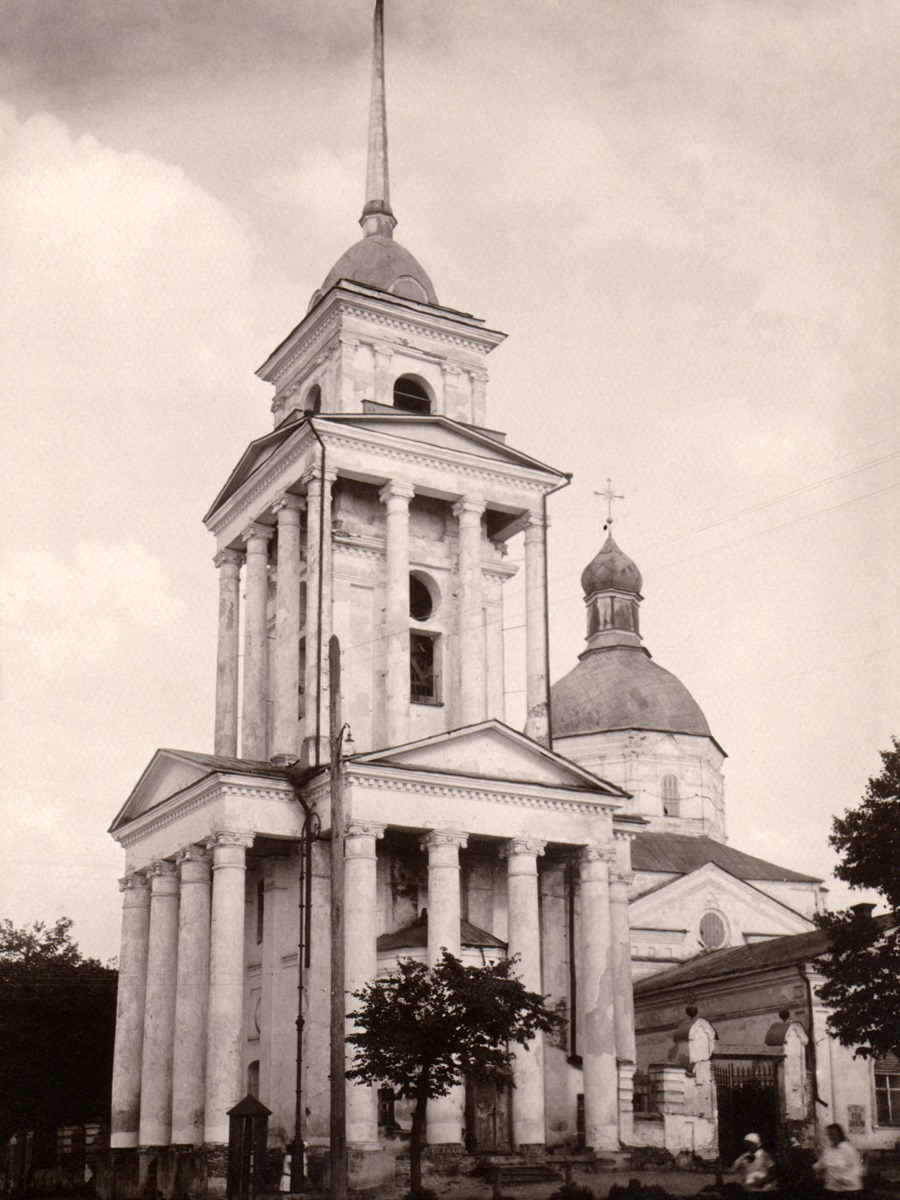
Bell Tower of Spaso-Preobrazhenska Tserkva
(Hlukhiv)
The Bell Tower of Spaso-Preobrazhenska Church is a sacred monument lost during the years of militant atheism. From the 1920s to the late 1930s, during the general Soviet campaign against religion as the “opium of the people,” the authorities of the Ukrainian SSR conducted a large-scale anti-religious campaign that led to the destruction of many religious structures.
The Bell Tower of Spaso-Preobrazhenska Church was located in the historical center of Hlukhiv, on the axis of Putyvlska and Shevchenko Streets. It was built at the beginning of the 19th century at the Spaso-Preobrazhenska Church, in the northwestern corner of the churchyard, as a functional and architectural element of the temple complex. Together with the Spaso-Preobrazhenska Church, the bell tower represented a characteristic example of sacral urban planning of the late 18th – early 19th centuries in Left-Bank Ukraine. Within the temple ensemble, the Classicist bell tower lent the complex monumentality and solemnity. It served as a vertical dominant, visually accentuating the center of parish life and orienting both residents and travelers.
Photographs from the late 19th and early 20th centuries still preserve the architectural composition: the Spaso-Preobrazhenska Church and, in the northwestern corner of the temple grounds, a brick, three-tiered bell tower in the Classicist style. The tower had a vertically tiered structure that gradually narrowed upwards. Its top was crowned with a high spire set on a dome, giving the building dynamic verticality. The first and second tiers were encircled on all four sides by columns—four on each side—forming a two-story portico on the lower level. These columns supported an entablature with a triangular pediment, a hallmark of Classicism. The middle and upper tiers featured large rectangular and arched openings that served as sound windows for the bells.
Overall, the bell tower’s architecture was enriched with profiled cornices and pilasters that structured the façade and created a striking play of light and shadow. Despite its monumentality, the building appeared elegant due to the refinement of its details.
The bell tower cannot be considered separately from the Spaso-Preobrazhenska Church itself, as although they were constructed at different times and in different architectural styles, they formed a single harmonious complex.
The stone, single-domed Spaso-Preobrazhenska Church in Hlukhiv is an outstanding monument of sacred architecture. It was built in 1765 at the expense of General Armata Ataman Hryhorii Kologryvyi under the supervision of architect Andrii Kvasov. The participation of Kyiv architect Ivan Hryhorovych-Barskyi in its construction is also possible. The church belongs to the type of tower-shaped churches and is one of the most artistically refined examples of the tetraconch type in Ukraine. (A tetraconch church is a type of Christian church characterized by a plan resembling a four-petaled flower, where four semicircular apses adjoin a square central volume, usually under a dome, forming a cruciform or square plan.)
The Spaso-Preobrazhenska Church was built during the period when Hlukhiv served as the Hetman’s capital (1708–1764), under Hetman Kyrylo Rozumovsky (1750–1764).
In 1867, a rectangular heated chapel was added to the western side of the Spaso-Preobrazhenska Church, which disrupted the original symmetry but expanded the interior space. The church has survived in this form to the present day.
The Bell Tower of Spaso-Preobrazhenska Church in Hlukhiv was demolished in the 1930s. The destruction of this architectural element disrupted the integrity of the sacred complex, violated its stylistic unity, and deprived it of the vertical dominant that had structured the urban composition.
The Spaso-Preobrazhenska Church itself survived, although in the 1960s the Sumy Regional Committee of the Communist Party of Ukraine demanded its demolition in order to “straighten” Putyvlska Street.
The era of militant atheism inflicted significant damage on Ukraine’s traditional architectural heritage. Churches were considered carriers of an ideology incompatible with the Marxist-Leninist worldview. As a result, thousands of religious buildings—including churches, monasteries, and bell towers—were closed, looted, and destroyed as symbols of spiritual authority.
In many cases, demolitions were carried out without specialists, using soldiers, laborers, and heavy machinery. Bells were removed and melted down, and religious buildings were either blown up or dismantled brick by brick. Their materials were often reused for the construction of clubs, schools, village councils, or even livestock facilities.
The anti-religious policies of the 1920s and 1930s left deep scars on the map of Hlukhiv: the city lost many religious landmarks that had defined the historical and architectural image of the former Hetman’s capital. The last known image of the Spaso-Preobrazhenska Church bell tower was captured by art historian Serhii Taranushenko during his 1930 expedition to the Left Bank. This photograph—discovered by the staff of the Hlukhiv National Reserve in the collections of the Institute of Manuscripts of the V. Vernadsky National Library of Ukraine—clearly shows that the bell tower stood in line with the western porch and the church fence. Therefore, locating the foundations of the lost monument presents no difficulty today. After the restoration of the church facades in 2010, attention has turned to the possible revalorization—the full reconstruction—of the destroyed bell tower.
The bell tower of the Church of the Spaso-Preobrazhenska of the Savior, together with the church itself, continues to attract scholarly interest, particularly in studies of regional history and its integration into the national cultural context. It has been established that the bell tower once housed an archive in a small, stone-vaulted room with a single round window for lighting.
Necropolis studies carried out in Hlukhiv over the past 10–15 years have identified and published lists of individuals buried in the churchyard of the Spaso-Preobrazhenska Church, and several individual tombstones have been documented.
Through archival research, journalism, epistolary materials, and digital 3D reconstructions, historians continue the long tradition of returning Hlukhiv’s lost architectural monuments to public awareness.
References
- Vechersky, V. Monuments of Architecture and Urban Planning of Left-Bank Ukraine: Discovery, Research, Documentation. Kyiv: A.S.S. Publishing House, 2005. 586 p.
- Vechersky, V. “The Soviet Era in Architecture and Urban Planning of Hlukhiv.” Preservation of Historical and Cultural Heritage of Hlukhiv Region: Proceedings of the 2nd Scientific-Practical Conference, April 17, 2013. Hlukhiv: RVV GSPU, 2003. pp. 92–95.
- Kovalenko, Yu. O. Historical Topography of Hlukhiv in the Medieval and Early Modern Periods. Nizhyn: PP Lysenko M. M., 2024. 224 p.
- Zadko, V. P. “Historical Heritage of the Hlukhiv Region.” Preservation of Historical and Cultural Heritage of Severshchyna: Proceedings of the 3rd Scientific-Practical Conference, April 16, 2004. Hlukhiv: RVV GSPU, 2004. pp. 84–90.
- Lost Bell Tower. Cathedral Square, 2010, No. 6, p. 3. Passport of the Cultural Heritage Site “Spaso-Preobrazhenska Church.” Security No. 180034–N. Scientific Archive of the National Reserve “Hlukhiv,” Inv. No. 3.