
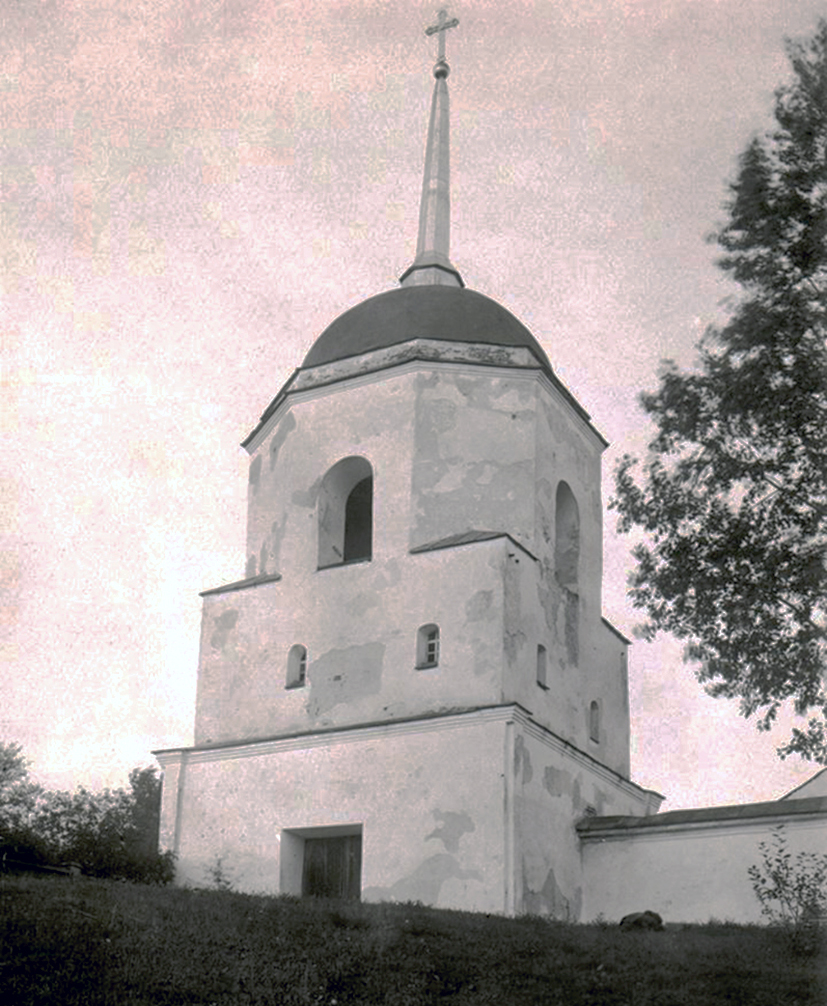
Gate Bell Tower
(Hamaliivka)
The defensive wall of the Hamaliivka (Gamaliev) Monastery, along with its Gate Bell Tower (now lost), was constructed between 1781 and 1794. Today, it is recognized as a monument of architecture and urban planning of national importance (Protection No. 180065/4). Together with the Cathedral of the Nativity of the Virgin (1719–1735), the Church of St. Haralampius (1714–1722), and the monastic cells (1781–1794), the fortifications form a single architectural ensemble representing the monastic heritage of the 17th–18th centuries.
Historical Background
The history of the Hamaliivka Monastery is closely connected with the Cossack elite of the Hetmanate period, particularly General Osavul Anton Hamalia and Hetman Ivan Skoropadskyi. The first wooden Church of St. Haralampius was built in 1702 at the expense of Anton Hamalia. Around it emerged the Haralampiivska Pustynka, a small nunnery. In 1713, through the efforts of Hetmansha Anastasia Skoropadska, the community was transformed into a full-fledged convent with official status, rights, and property.
In 1714, Hetman Ivan Skoropadskyi declared himself patron (titar) of the Hamaliivka Monastery. He personally financed the construction of masonry buildings, which he considered his family monastery — a symbol of hetmanal prestige and piety.
Defensive Design and Symbolism
The architectural concept of the Hamaliivka Monastery followed the model of a fortified monastery, inspired by the nearby Transfiguration (Spaso-Preobrazhensky) Monastery in Novhorod-Siverskyi. Given the military-political context on the Northern Left Bank after the Battle of Poltava (1709), the construction of such a powerful fortress-like complex—particularly for a women’s monastery—seems to have been more symbolic than practical. The strong brick walls and towers embodied the idea of a “spiritual fortress”, representing steadfast faith and divine protection rather than military defense.
The defensive walls formed an irregular trapezoid measuring approximately 170 × 180 meters. Built of brick, the walls stood 2.2 meters high and 1.3 meters thick, with four octagonal corner towers featuring pilasters at the edges. Numerous loopholes were positioned about 1.2 meters above the ground.
At the center of the southern wall, there was an additional octagonal tower with a utility gate. Architecturally elegant, the towers rested on profiled bases and were crowned with multi-layered cornices supported by pilasters. The tower adjoining the two-story rectory building was simpler in design and projected outward beyond the defensive line. Each tower contained battle chambers with loopholes and was originally covered with high, tent-shaped shingle roofs, later replaced (after 1794) by spherical metal-clad domes.
The Gate Bell Tower
The Gate Bell Tower, located in the western wall (now lost), served as the main entrance to the monastery. Positioned on the longitudinal axis of the cathedral, it was the architectural and symbolic focal point of the ensemble.
The tower was three-tiered: the two lower tiers were square in plan, while the third was octagonal. It was crowned with an elaborate Baroque cupola. The façades were decorated with brick-lined and plastered architectural details — pilasters, niches, and cornices.
The first tier contained the arched passageway with auxiliary rooms and staircases on either side, leading to the second tier, which housed the Gate Church of the Presentation of the Virgin. The third tier, octagonal in plan, featured arched openings on each face for the bells.
A three-bay gallery with semicircular arches supported by rectangular pillars complemented the upper structure. Its decoration was restrained, limited to a cornice and a profiled base. This gallery still existed in the 1820s, as shown on the monastery plan (1820–1826) compiled before the later Empire-style renovations.
Completed by 1722, the Gate Bell Tower was a simplified replica of the Holy Gate of the Transfiguration Monastery in Novhorod-Siverskyi, which Hetman Skoropadskyi admired for its functionality and elegance.
The Northern Gate Tower
At the bend of the northern wall, another two-tiered, four-sided gate tower was originally constructed. Its design resembled an ancient “zahab” (a fortified entrance). The first tier had two compartments: a northern section with an arched passage and a southern section with two guard chambers. The passage ran parallel to the defensive wall, allowing crossfire protection from nearby loopholes and corner towers. The second tier contained a combat gallery. The tower was covered with a gable roof.
Architectural and Cultural Significance
Through its austere proportions and monolithic design, the Hamaliivka Monastery ensemble projected the image of a severe, impregnable fortress. It represents the final stage in the evolution of defensive monastic architecture on the Left Bank of Ukraine and stands as the artistic culmination of a centuries-old building tradition that combined spirituality and fortification.
Preservation and Modern Status
Recognizing its exceptional cultural, historical, and architectural value, on June 19, 2019, the Cabinet of Ministers of Ukraine adopted a resolution establishing the State Historical and Cultural Reserve “State Builders of the Sivershchyna”, which included the Hamaliivka Monastery ensemble.
However, on July 21, 2021, this decision was revoked as unimplemented. Subsequently, on October 13, 2023, the Cabinet of Ministers of Ukraine granted the Hamaliivka Monastery ensemble the status of a monument of architecture and urban planning of national importance.
Today, the monastery’s unique architectural and historical significance ensures its inclusion in modern cultural and tourist routes. The Hamaliivka Monastery ensemble, with its symbolic Gate Bell Tower and fortifications, remains a central site of interest for visitors exploring the spiritual and architectural heritage of northern Ukraine.
References
- Vecherskyi, V. Lost Objects of Architectural Heritage of Ukraine. Kyiv: NDITIAM – Holovkyivarkhitektura, 2002. 592 p.
- Vecherskyi, V. Orthodox Shrines of the Sumy Region. Kyiv: Tekhnika, 2009. 224 p.
- Yurchenko, S. B. “The Hamaliivka Monastery during the Time of Hetman Ivan Skoropadskyi.” Severshchyna in the History of Ukraine, 2012, No. 5, pp. 30–35.
- Chernyakova, Ya. V. “The Hamaliivka Haralampiiv Monastery: An Architectural Monument or a Prison?” Karnabidiv Readings, 2019, No. 4, pp. 248–253.
- “Hetman Family of Skoropadskyi.” Hetmanshchyna website. Available at: https://hetmanshostka.in.ua/ (accessed 14 Sept 2025).