
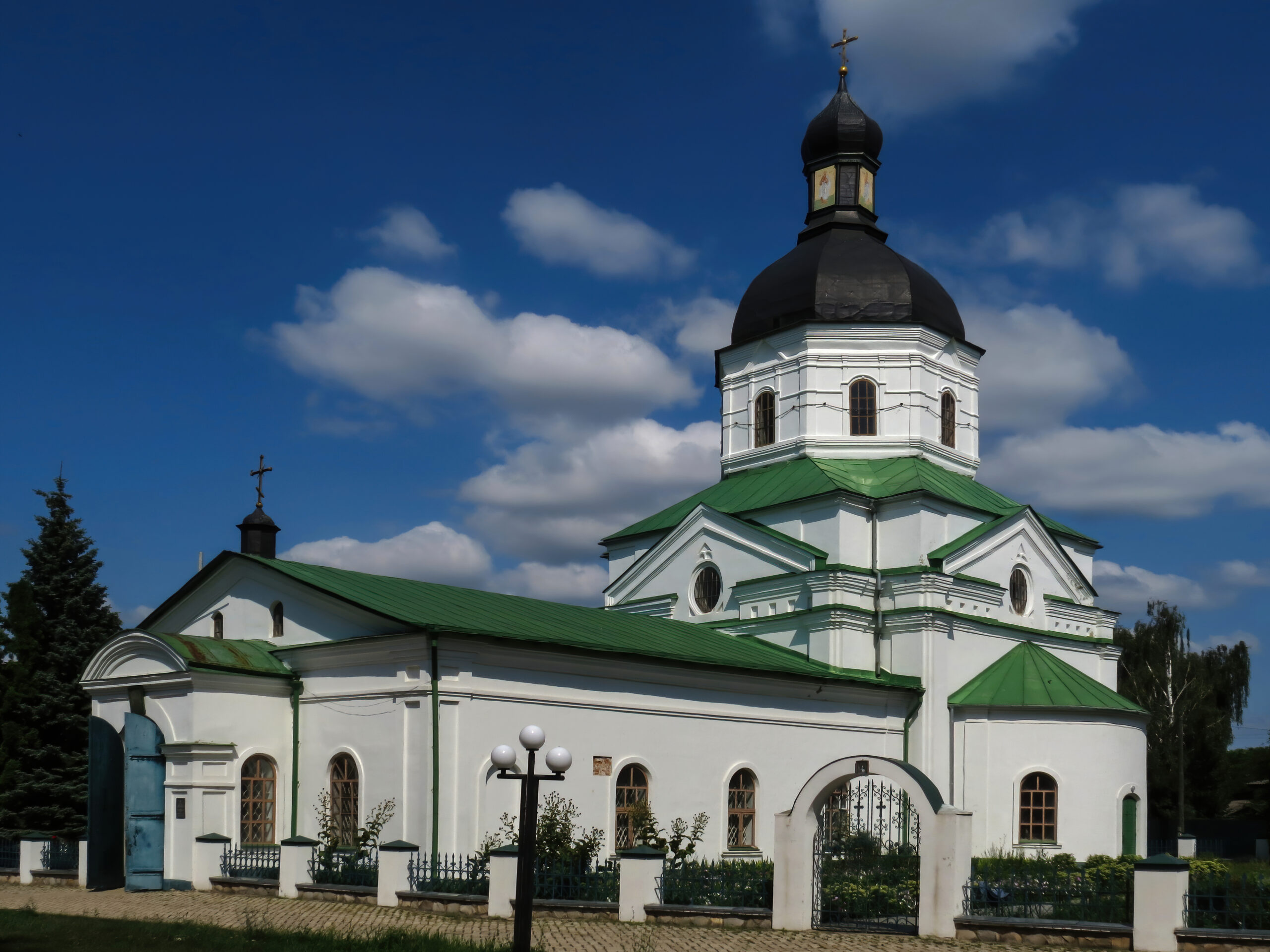
Spaso-Preobrazhenska Tserkva
a monument of history, architecture, and urban planning of national importance
(Hlukhiv, Spaska St., 4)
The Spaso-Preobrazhenska Church is one of the most prominent architectural landmarks of Hlukhiv.
Built in 1765 at the expense of Hryhorii Kologryvyi, Ataman of the General Armata (the central artillery administration of the Zaporizhian Host), the church was constructed under the supervision of architect Andriy Kvasov. Some sources also suggest the involvement of Ivan Hryhorovych-Barskyi, a noted Kyiv architect.
The brick, single-nave Spaso-Preobrazhenska Church stands in the historical center of Hlukhiv, at the intersection of Putyvl and Shevchenko streets. Its architectural prototypes were the Ascension Church in Korop and the Three Hierarchs Church in Lemeshy (Chernihiv region). The new church was erected on the site of an earlier wooden Spaso-Preobrazhenska Church, which had burned down in the great fire of 1748.
In 1855, architect A. Assing designed an extension on the western side—a heated winter church, completed in 1867, which slightly altered the original symmetry of the structure.
Architecturally, the Spaso-Preobrazhenska Church belongs to the type of tower-shaped tetraconchs with a clearly defined central quadrangle. Its elegant design combines balanced proportions, refined decorative details, and a well-developed vertical composition. The restrained façade is adorned with pilasters, arched windows, triangular pediments, and delicate cornices. The interior, with its whitewashed walls and preserved medallion paintings of the Evangelists, impresses with its spatial harmony and height dynamics.
During the Soviet era, the church was closed in 1961, and authorities planned its demolition in the 1970s. However, in 1979, it was granted the status of a national monument (protection number 180034–N), which ensured its preservation.
Comprehensive restoration works were carried out by the Ukrproektrestavratsiya Institute under architect S. Halep between 1982 and 2010. In 2008, during restoration, experts discovered unique 18th-century frescoes beneath multiple layers of whitewash — the only surviving authentic wall paintings in Hlukhiv.
Today, the Spaso-Preobrazhenska Church remains one of the most artistically refined examples of Ukrainian baroque architecture and is included in the “Temples of Hlukhiv” and “City Tour” routes of the National Reserve “Hlukhiv”.
References
- Vechersky V. Monuments of architecture and urban planning of Left-bank Ukraine: discovery, research, fixation. Kyiv: Publishing House A.S.S., 2005. 586 p.
- Vechersky V., Belashov V. Glukhov. Small historical cities of Ukraine. Kyiv: Abrys, 2003. 168 p.
- Kovalenko Yu. O. Historical topography of Glukhov in the medieval and early modern periods: monograph. Nizhyn: PP Lysenko M. M., 2024. 224 p.
- Shishkina Yu. A. Parish life of the city of Glukhov in the late 19th – early 20th centuries. Siverschyna in the history of Ukraine. 2014. No. 7. P. 208–213.
- Shishkina Yu. A. Activities of architect Andriy Kvasov in Glukhov. Siverschyna in the history of Ukraine. 2016. No. 9. P. 263–266.
- Bartosz A. Ye., Marampolska V. A. Unique find of 2008. Siverschyna in the history of Ukraine. 2010. No. 3. P. 19–21. Passport of the cultural heritage object “Savior-Spaso-Preobrazhenska Church”. Security number 180034–N. Scientific archive of the National Reserve “Glukhov”, inv. No. 3.